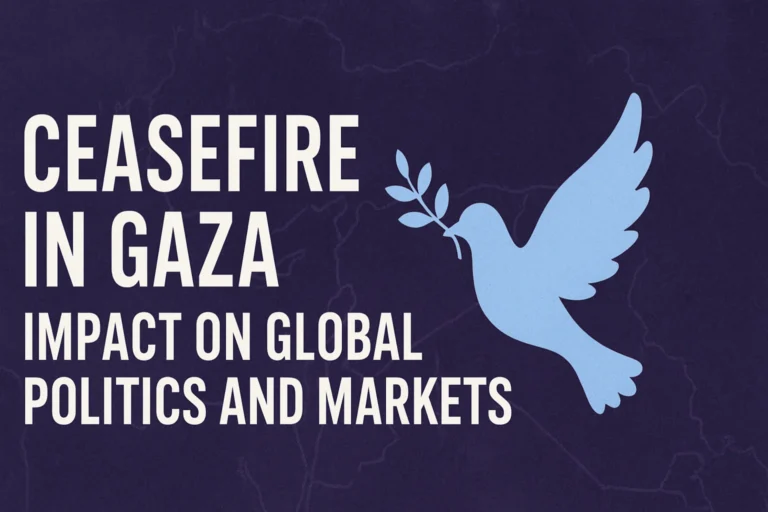

A new wave of cautious optimism has spread across the world following the announcement of a ceasefire between Israel and Hamas. The deal, facilitated by the United States with backing from regional partners like Egypt and Qatar, aims to halt months of devastating conflict in Gaza.
While the humanitarian relief is immediate, the political and financial implications of this ceasefire extend far beyond the Middle East, influencing global markets, diplomatic relations, and regional energy stability.
Diplomatic Significance
United States: Reasserting Global Leadership
For Washington, the ceasefire is a chance to reassert its influence in a region where China and Russia have sought a greater foothold. President Biden’s administration is positioning this as a diplomatic win, emphasizing America’s ability to mediate through its allies.
United Kingdom and Germany: Balancing Support and Criticism
Both London and Berlin have expressed strong support for the truce while maintaining pressure for long-term peace talks.
Germany remains a key supporter of Israel but is increasingly vocal about humanitarian aid to Gaza.
The UK, focused on post-Brexit global influence, has reaffirmed its role as a “bridge” between the U.S. and EU positions on the conflict.
Pakistan: Advocating for Palestinian Rights
Pakistan’s government welcomed the ceasefire as a step toward justice, reiterating its long-standing support for the two-state solution. Public sentiment remains deeply sympathetic to Palestinians, making this issue a recurring theme in Pakistan’s foreign policy.
Economic and Market Reactions
Oil Prices Ease Amid Stability Hopes
Energy markets reacted swiftly to the truce, with Brent crude and WTI prices dipping slightly as fears of supply disruptions eased. Analysts believe that if the ceasefire holds, energy volatility in Europe, especially for Germany and the UK, could temporarily stabilize.
Investor Confidence and Risk Appetite
Stock markets in the U.S. and Europe showed modest gains after the ceasefire news. Investors see the development as a sign of reduced geopolitical risk, which typically supports:
Stronger equity performance
A mild rise in government bond yields
Short-term strengthening of the U.S. dollar
Trade and Regional Stability
The Middle East remains a key corridor for global trade and shipping. Reduced conflict risk could prevent further disruptions in Red Sea and Mediterranean routes, vital for Europe’s supply chains.
Political Implications for 2025
For the U.S., success in stabilizing Gaza strengthens President Biden’s diplomatic credentials ahead of the 2025 elections.
In Europe, Germany and the UK may push for renewed EU involvement in post-war reconstruction efforts.
For Pakistan, this truce enhances its diplomatic standing in the Muslim world, especially if it contributes to regional aid or peace initiatives.
However, experts warn that without a clear roadmap toward Palestinian statehood, the truce could be temporary — a pause rather than a resolution.
Humanitarian and Social Outlook
The ceasefire brings a long-awaited moment of relief for millions of civilians in Gaza who have endured months of relentless conflict, displacement, and scarcity of necessities. For families living under siege conditions, even a temporary halt to hostilities means a chance to access food, clean water, medical supplies, and safe shelter.
International organizations including the United Nations, the Red Cross, and several European humanitarian agencies are mobilizing rapidly to scale up aid deliveries across Gaza. Convoys carrying medicine, baby formula, and fuel are expected to cross the Rafah border in the coming days, signaling the first significant flow of humanitarian assistance since the fighting began.
Germany and the United Kingdom have pledged substantial increases in humanitarian funding, focusing on medical care, reconstruction support, and food security. Berlin’s foreign office announced a new aid package aimed at strengthening hospitals and refugee assistance programs, while London has promised to coordinate with the UN to ensure fair and efficient aid distribution. Both nations have also emphasized accountability, urging Israel to allow uninterrupted humanitarian access to affected areas.
Meanwhile, Pakistan has strongly condemned the civilian toll of the conflict and renewed its call for an international inquiry into alleged war crimes committed during the escalation. Pakistani civil society groups and NGOs are also preparing relief initiatives, highlighting the country’s growing humanitarian role in the Muslim world.
Despite these positive steps, the situation remains fragile. Much of Gaza’s infrastructure including hospitals, schools, and water systems, has been severely damaged or destroyed. Humanitarian experts warn that without sustained access and long-term reconstruction plans, the ceasefire’s benefits could be short-lived.
For many in Gaza, peace means more than the absence of bombs; it represents the hope of rebuilding lives, restoring dignity, and ensuring that future generations can grow up free from fear. The current ceasefire offers an opportunity for the international community to turn expressions of sympathy into tangible action not only through aid, but by supporting justice, development, and sustainable peace in the region.
Conclusion
The Gaza ceasefire marks a critical geopolitical turning point. Beyond ending violence, it signals shifting alliances, renewed diplomatic opportunities, and potential calm for jittery global markets.
Whether this moment evolves into a lasting peace or fades into another fragile truce depends on the political will of all involved and the world’s readiness to support a sustainable future for Gaza.